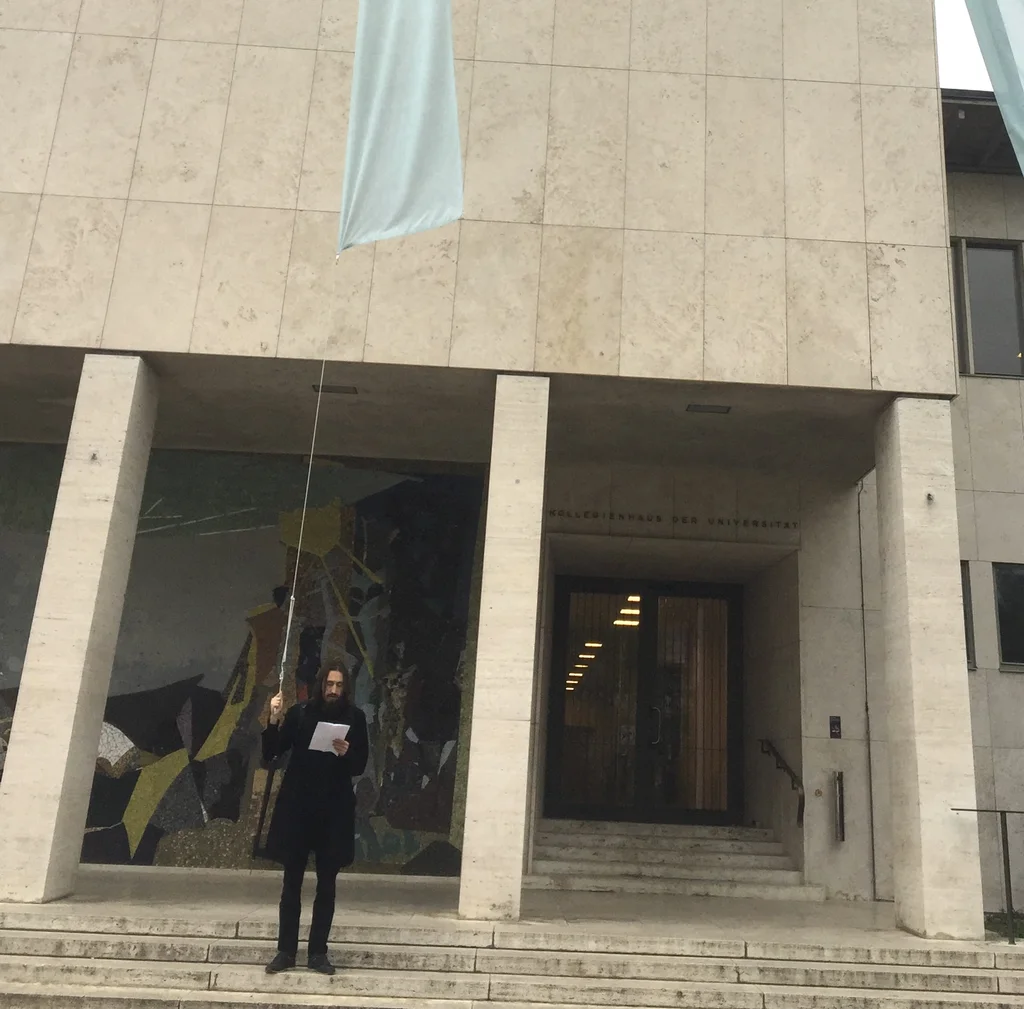

Dear researchers,
It seems to me that our democratic societies are being shaken up by social media. They must now grapple with the possibilities offered by today’s information technology to determine what forms of “public sphere” exist, might exist, and which, moreover, are conducive to democracy.
This is happening very slowly, however. I cannot recall ever having read a journalistic article that addressed the structural nature of our public spheres. Perhaps I simply don’t read enough newspapers. For a long time, the response was a very superficial “We need more of a culture of debate.” Today, calls are being made for digital sovereignty and the algorithmic control of news feeds is being criticised, which does get closer to the heart of the matter.
If people act within social frameworks that are half designed and half historically evolved, what place would an Instagram feed, for example, have in a desirable public sphere of tomorrow? Are there examples of good algorithms? And shouldn’t there be a multitude of social media platforms with different designs for different purposes, which people can engage with as needed (rather than out of dependency)? What examples (not just digital ones) are there of how public spheres have been established? savoirpublic.ch is certainly a very interesting experiment!
And: What does a pragmatic, application-oriented concept of the public sphere look like? Must the public sphere be conceived in terms of an ‘object’? – After all, I can only take a stance on something. So is the ‘object’ of the public sphere necessary? In this case, the object would be my question(s) and the social development to which they relate. And what about ‘subjects’ of the public sphere with different understandings of their roles (with a framework for their own thinking and action)?
Such a pragmatic, application-oriented concept of the public sphere could, for example, help me to establish a non-existent student public sphere at a university.
That covers the scope of the question; now, to be quite specific once again:
1. Are there any interesting examples that can help us better understand how a public sphere can be established (digitally, hybrid, or analogously)?
2. What is a pragmatic, application-oriented concept of the public sphere?
Many thanks and best regards, Léonard
Dear Léonard,
thank you for this question, which, as you’ve phrased it, already highlights some of the complexities of the subject.
I shall first attempt briefly to reflect the scope of your question, in order to highlight what particularly stood out to me, how I understand it, and the approach I wish to take in responding to it. I will then outline two possible responses to your specific questions: (1) examples illustrating how public spheres are established, and (2) a pragmatic, application-oriented concept of the public sphere that can be applied both in higher education contexts and beyond.
The public sphere as a socially shaped environment
What particularly appeals to me about your question is that you do not conceive of the ‘public sphere’ as an abstract space, but rather as a socially shaped environment in which people act – on the one hand planned and intentional, and on the other hand historically evolved and shaped by cultural habits. You’re not just asking: What is the public sphere?, but: How is it structured? Which designs promote or hinder democratic practice? What role do algorithmic infrastructures play? Are different public spheres needed for different purposes? And finally: How can we develop a concept of the public sphere that is practically useful – for example, in building a student public sphere?
In doing so, you shift the focus from normative appeals (keyword: ‘more of a culture of debate’) towards (infra)structures and roles. In my view, this is crucial.
Coordinated attention…
From my anthropological and philosophical perspective – particularly based on my work on divided societies and their patterns of attention – I would also emphasise the following: On the one hand, public spheres are historically, politically and culturally specific. They emerge within particular institutional orders, media infrastructures and power constellations. On the other hand, however, they are also based on an anthropological constant. People must coordinate their attention. We are beings who not only exist side by side ‘in the same world’, but who relate to certain aspects – a topic, a problem, an event – which are what shape our lifeworlds in the first place. We gather around something, make it the object of shared perception, and in doing so exclude other things.
…as an anthropological constant
In this sense, the public sphere is a specific manifestation of a general conditio humana: the necessity to focus and distribute attention, thereby becoming mutually addressable. This basic structure makes the concept of the public sphere universally comprehensible – even if its concrete forms, lines of conflict and regimes of visibility vary greatly depending on the social context.
Different focal points of attention: South Africa, the USA, Switzerland
In my research, I work within various social contexts – including Switzerland, South Africa and the USA – and observe how differently these historical and institutional embeddings manifest themselves: In South Africa, issues of race and public space remain materially and omnipresently embedded to this day (keyword: apartheid); in the USA, race, class and gender structure many public spheres; in Switzerland, other, more subtle axes also come into play – such as multilingualism, federalism or the institutional proximity between politics and the citizenry.
Visibility and invisibility
Public spheres carry their historical fault lines within them – they are never neutral, but rather sedimented politics of attention. They are not only places where opinions are formed, but also places of visibility and invisibility. (Who speaks out and is heard? Who remains silent? Who appears as a legitimate subject of discourse? And who is structurally marginalised – by design, by history, by implicit norms?)
The digital economy of attention
In digital public spheres, this question becomes even more acute: algorithmic feeds determine what becomes visible and what disappears. Yet analogue public spheres – such as universities, town hall meetings or the media – also function through implicit attention economies.
Your question about an ‘object’ of the public sphere is very fruitful in this context. The public sphere does not arise in a vacuum. It forms around something – a topic, a problem, a decision, a concern. This ‘something’ structures attention and roles. At the same time, the ‘subjects’ of the public sphere are also shaped within this process: as questioners, those affected, experts, facilitators and decision-makers.
From this perspective, the public sphere is less a finished space than a processual framework of relationships – historically situated, powerfully structured and, at the same time, malleable.
From here, I would now like to move on to your two specific questions.
1) Examples: How the public sphere is ‘organised’ (analogue, hybrid, digital)
a) The public sphere as infrastructure (not merely as an ‘exchange of views’)
The public sphere depends on access, visibility and categorisation. The EU is attempting to address this structurally through the Digital Services Act (DSA) – amongst other things, via obligations regarding transparency, risk mitigation (e.g. for civil discourse / elections) and recommender systems. Switzerland is also moving in this direction: on 29 October 2025, the Federal Council submitted a draft bill for consultation on the regulation of very large communication platforms and search engines (including fairness and transparency obligations).
These are examples of how ‘public sphere’ is negotiated at an institutional and technical level.
Pragmatic takeaway: The public sphere requires carefully designed rules governing (i) access, (ii) attention (ranking/agenda), (iii) accountability (who decides on visibility, why, and what legal remedies are available?)
b) Deliberative formats: Citizens’ Assemblies (in-person & hybrid)
These formats are interesting because they deliberately design the public sphere: selection (e.g. random selection), moderation, documentation, feedback to politics/institutions. Their strength: They partially decouple public judgement-forming from ‘volume’ and reward reasoning rather than reach.
Takeaway: ‘Good’ public spheres are often multi-stage: listening/learning → discussing → publicly justifying → providing binding feedback.
c) Digital alternatives: chronological feeds, transparent freedom of choice, breaks
Your idea – “a multitude of social media platforms with different designs for different purposes” – hits the nail on the head: A public sphere compatible with democracy needs options rather than dependencies.
What counts as ‘good algorithms’ is not so much a perfect ranking as controllable visibility:
- Choice by design: Users can choose between feeds (chronological, thematic, local, curated).
- Transparency + auditability: it is clear why something appears in the feed; data access for research/oversight. (This is precisely where the DSA comes in.)
- Friction rather than pull: limiting autoplay and infinite scroll, clear pauses, ‘Are you sure?’ moments – not as a moralising tool, but as an architecture for attention.
Concrete digital examples of this would be Mastodon – a federated model without a centralised ranking logic, featuring chronological feeds and community rules instead of a global algorithm. Wikipedia also springs to mind in this context – not a feed, but a topic-oriented public space for individual articles. Visibility here arises through relevance criteria, which are constantly re-evaluated on discussion pages.
Takeaway: A democratic digital public sphere should be less of a ‘feed’ and more of a toolbox (different modes for different purposes).
2) A pragmatic, application-oriented concept of the public sphere
I propose a concept that is philosophically compatible and takes seriously, from an anthropological perspective, the fact that public spheres are constructed and inhabited unequally:
The public sphere as an arrangement of shared reference. Let me briefly unpack this:
The public sphere is an arranged relationship in which people
- become mutually addressable
- around a certain thing (topic/problem/‘object’)
- become mutually addressable
- under rules/media/infrastructures that
- distribute visibility and voice unequally.
The ‘object’ is not merely a topic of discussion, but that which is shaped into a form capable of stabilising shared attention: the specific framing of a question, a conflict or an event.
Roles rather than abstract ‘subjects’
It is pragmatically helpful not to speak of ‘the public’, but of roles that can (ideally) be rotated:
- Questioners / Those affected
- Interpreters (who mediate between experiential knowledge and specialist knowledge)
- Moderators (who ensure speaking times, tone and focus)
- Scrutinisers (facts, sources, conflicts of interest)
- Decision-makers (who bear responsibility for taking or refraining from action)
In this way, the public sphere becomes capable of action, without assuming that everyone can, wants to, or ought to be equally competent, equally confident or equally vocal at all times.
A mini-blueprint for a ‘student public sphere’ at a university
If you want to establish ‘a non-existent student public sphere’, I would start with three design principles:
- Topics should be clear but plural: Not ‘the big debate’, but several issue-based public spheres (e.g. housing, curriculum, discrimination, examination formats), each with its own rhythm and opportunities for participation in the discourse.
- Hybrid + low-threshold: a physical location (regular, visible) + a digital space (archivable, searchable) + clear transitions between the two.
- Visibility equity: Facilitation, speaking time rules, anonymous channels for sensitive topics, rotating roles, and a mechanism that translates suggestions into binding commitments (minutes, feedback loops, responsibilities).
Thanks again for your question! I hope my suggested answer helps you.
Kind regards
Anna

Wonderful! Your answer really helped me out. Thank you for your great work!