
“One day, the fire will spread from Carcassonne to the sea.”
Philippe Menziols, director of the Aude Winegrowers’ Association
What does good farming in the south of France look like as the climate gets warmer?
Farming that
• is focused on the long term
• protects resources and the environment
• uses water sparingly
• safeguards biodiversity
• protects against forest fires
• enables people to earn a living and find meaningful work
• makes rural (so-called ‘structurally weak’) regions attractive places to live again, including for young people
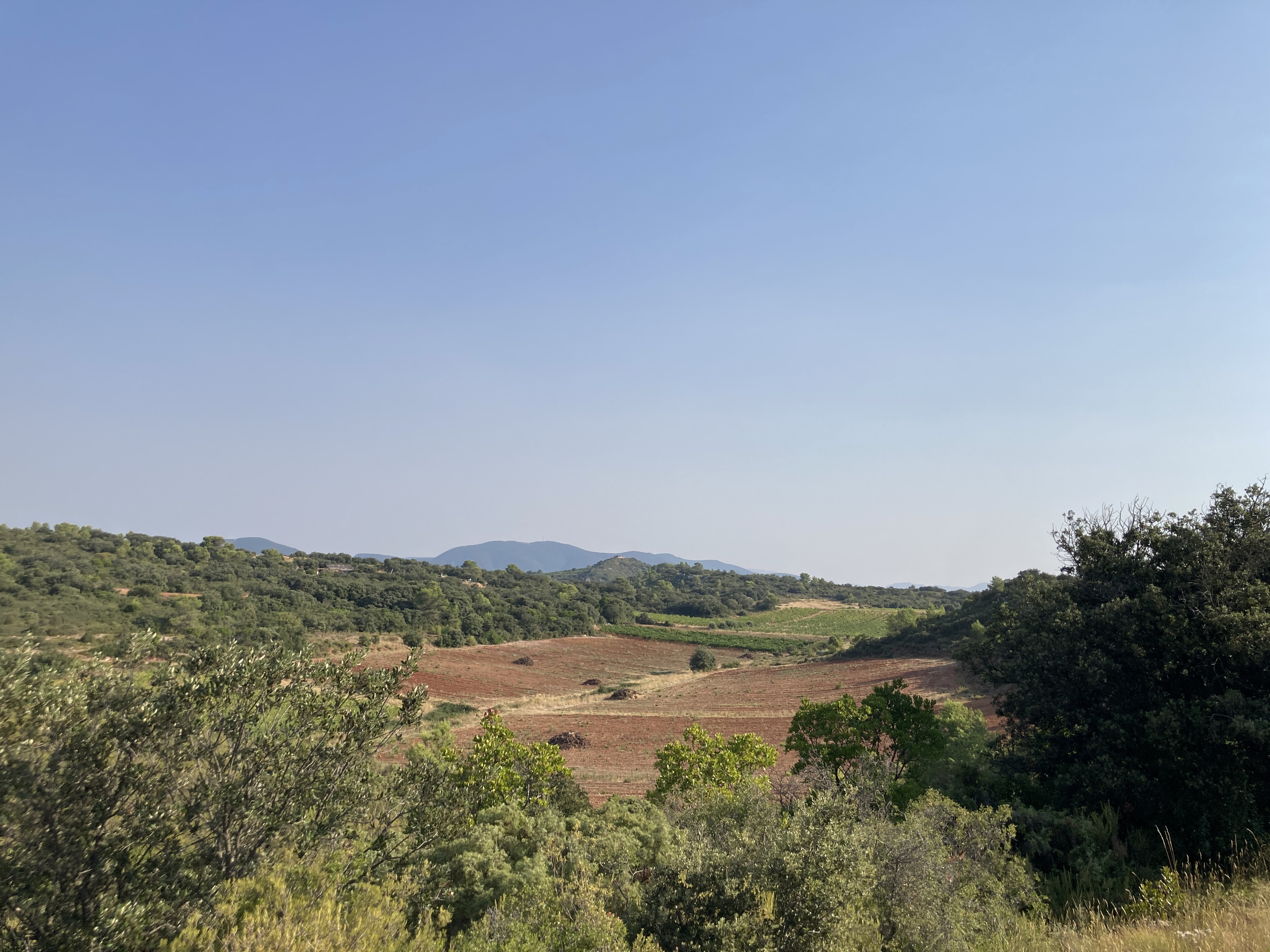
How the question arose: We have a house in the south of France. It is situated on the outskirts of a small village. Behind the house lies the garrigue, the heathland of the south. The major forest fire in the Corbières at the start of August was only 40 kilometres away as the crow flies. That could happen here too. The climate, landscape and weather conditions are similar to those in the Corbières. Strong winds often blow.
The village is surrounded by vineyards. Many vines are now being grubbed up; 60 hectares will be removed in 2025 alone. France produces too much wine. People are drinking less wine. The government pays winegrowers who grub up their vines permanently; they receive a subsidy of 4,000 euros per hectare. Yet vineyards provide natural protection against forest fires. They slow down the spread of the flames. The Aude is the département where the most vines have been grubbed up. The figure mentioned is 5,000 hectares. The landscape of southern France is characterised by viticulture.
In recent years, more olive trees have been planted. They are intended to compensate for the unpredictable yields from the grape harvest. This is because the drought is also taking its toll on the vines. The climate will continue to warm. Drought conditions are worsening because there is much less rainfall. Sometimes there is no rain for several years running. Hot summers with heatwaves will become more frequent. The wind cannot be stopped.
What will happen to the former vineyards? Will they become overgrown? Anyone receiving the grubbing-up subsidy is obliged to mow the grass. Who monitors this? Is fallow land a bad thing? Are grape varieties that are better adapted to heat and drought part of the solution? Which crops could replace vines? What could other production methods, such as permaculture, agroforestry and forest gardens, offer?
Good afternoon, Ms Rigendinger
Thank you very much for your excellent question! I’m not a specialist in the South of France, and as an agricultural sociologist, I actually know more about what people consider to be good farming than I do about what good farming actually is.
However, your question is excellent and I’d be happy to attempt an answer from my perspective. Mind you, this will only be in general terms. For an answer tailored to the south of France, you should definitely consult a specialist in southern French agriculture.
As well as the main question, you’ve asked many detailed questions. I’ll address the main question first. It requires a very different answer to the detailed questions. I’ll give you my assessment of those at the end.
Industrial versus small-scale farming
If only we had a single good answer to your question!
At present, we tend to feel that industrial farming, characterised by monocultures, looks unattractive. By contrast, we consider small-scale, diverse farming to be both sustainable and beautiful. Many people believe this is justified. After all, small-scale farming uses fewer pesticides; the hedgerows at the edges of fields break the wind and prevent the loss of nutrients. Keylines retain rainwater when there is too much rain and make it available during dry spells. Animals graze in the pastures rather than being fattened up in stables. Farmers and farm workers pursue fulfilling, self-determined work.
High versus low yield per unit area
However, this idyll is undermined by its land consumption. At least where skilled labour is a limited resource, the yield per unit area of conventional industrial agriculture is higher than that of small-scale farming. With a growing population and rising demand for agricultural goods, small-scale farming requires more land than industrial farming. The question is whether we should still opt for small-scale farming if it means sacrificing further ecosystems.
However, there are some flaws in the land-use argument. For example, when you compare it to the land-intensive consumption of meat, which industrial agriculture drives up through advertising and lobbying, only to pat itself on the back for meeting that demand.
Costs for people on low incomes
Nevertheless, the argument cannot be entirely dismissed, particularly when one considers that people on low incomes generally have a relatively small ecological footprint. Despite their small footprint, in a world of mandated small-scale agriculture they would have to bear a relatively high proportion of the associated cost increases.
Progress in both forms of agriculture
The need for discussion is currently greater than ever, especially as the opposing camps seem to be finding it increasingly difficult to understand one another. This is a pity, in that the further development of both sides is not a contradiction in terms. Why shouldn’t both industrial and small-scale farming improve their performance?
The arguments in favour of industrial agriculture can only be sustained if it can reduce the leaching of the pesticides, antibiotics and fertilisers used in it. Alongside good industrial agriculture, ecosystems must not look as though they have been treated with chemicals.
In small-scale farming, agroforestry enthusiasts are demonstrating that astonishingly high yields can be achieved in food forests (even if a field of wheat still yields a higher yield per unit area). However, small-scale farming should not always look like a forest, but perhaps only in parts. If, however, small-scale farming switches to overly extensive management, its appeal is lost due to insufficient yield per unit area.
Infrastructure
Both industrial and small-scale farming must adapt to changing conditions. Simply maintaining the status quo is not an option in the face of changes to the climate and consumer behaviour. However, for change to take place, varieties, agricultural inputs, expertise and distribution channels must also be available. Not all agricultural problems can be solved within the agricultural sector itself. Sustainable agriculture must be underpinned by an infrastructure that allows for the further development of various agricultural practices and their adaptation.
Crop breeding
In my view, how sustainable a region’s agriculture is depends heavily on the progress made by crop breeding institutions. Backcrossing high-yielding varieties with old, hardy varieties is one of agriculture’s great success stories. In my view, pesticides, genetic engineering, permaculture gardens and agroforests pale in comparison to plant breeding.
That was my general response regarding what constitutes good agriculture.
Now a few answers to your specific questions:
- Do former vineyards become overgrown with scrub?
If they are no longer cultivated and there are no animals to create a savannah-like grazing landscape: yes. The vineyards will first become overgrown with scrub, then turn into woodland if no fire clears the area again.
- Who monitors whether land is kept open?
In the Alps, satellite imagery is used to monitor whether land is kept open. In principle, this works. However, the images can – or could – be misled by the short-term clearing of scrub.
- Is fallow land a bad thing?
Not necessarily. Over time, fallow land naturally reverts to a near-natural ecosystem. In the process, there are winners and losers. However, restoring land that has been left fallow for a long time to agricultural use is a very labour-intensive process.
- Are grape varieties that are better adapted to heat and drought part of the solution?
In principle, yes! However, increasing drought resistance through breeding and genetic engineering is unlikely to succeed without a loss of yield. We have relieved plants of the burden of having to arm themselves against heat and drought. At the same time, we have bred the resources thus freed up by the plants into their fruit. It is unlikely that, in the near future, we will succeed in reinventing the drought resistance of the plant world – developed over thousands of years of evolution – in such a way that maximising yield and heat resistance are no longer mutually exclusive.
- Which crops could replace vines?
In principle, many options are conceivable here. However, changing the infrastructure on farms is expensive and time-consuming. Which crops could replace vines whilst making use of the existing machinery, know-how, terraced land and field sizes on farms? I do not feel qualified to answer that.
- What would a form of agriculture look like that makes structurally weak rural regions attractive again?
That is another major question to which we as yet have no satisfactory answer in research. We know that programmes which have pursued this aim, in particular the European Union’s Common Agricultural Policy, have largely failed to date.
There are probably two reasons for this: on the one hand, too large a proportion of funding is likely going to regions with large, structurally strong farms. Secondly, it is thought that agriculture is not the decisive factor in a region’s structural strength or weakness. To safeguard agriculture in a region, the region’s non-agricultural structure must (also) be strengthened accordingly. The European Union’s LEADER programme was developed on the basis of this insight. Unfortunately, despite promising interim results, it is allocated only limited funding.
I hope this response has at least partially answered your question. And I hope that an expert on agriculture in the south of France will be able to provide you with even more detailed information on the extent to which the measures currently being implemented there are effective.
Kind regards, Moritz Maurer
Your answer shows that we get further with a ‘both…and’ approach than with an ‘either…or’ one. I’m now curious to see what the results of plant breeding will be.

Thank you very much for the accurate and informative answer.